
Bitcoin Halving Cycles Explained: What the Data Shows
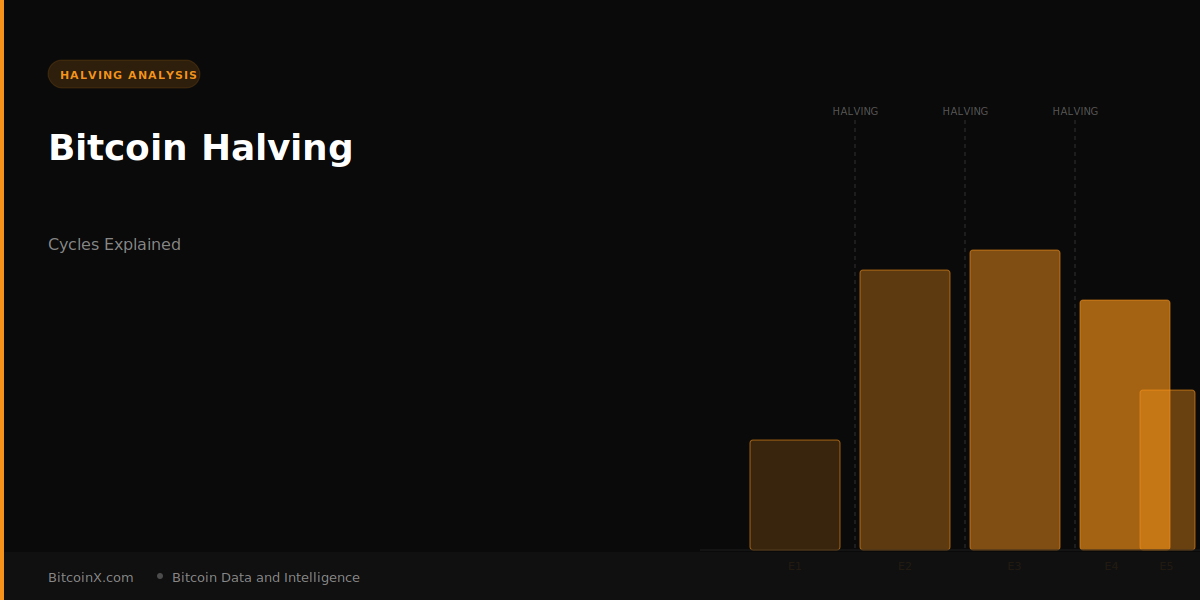
Every four years — or more precisely, every 210,000 blocks — the Bitcoin network cuts its block reward in half. This event, known as the halving, is the single most important scheduled event in Bitcoin’s calendar. It is hardcoded into Bitcoin’s protocol and will continue until all 21 million Bitcoin have been mined, expected around the year 2140.
What Is a Bitcoin Halving?
When Satoshi Nakamoto launched Bitcoin in January 2009, miners received 50 BTC for every block they successfully added to the blockchain. That reward halved to 25 BTC in November 2012, then to 12.5 BTC in July 2016, then to 6.25 BTC in May 2020, and most recently to 3.125 BTC in April 2024. Each of these events is a halving.
The purpose is simple: to control the supply of new Bitcoin entering circulation. By design, Bitcoin becomes harder to produce over time. This is the opposite of how traditional currency works — central banks can print dollars without limit, but no one can print Bitcoin.
The Four Halving Epochs
Bitcoin’s history can be divided into five distinct epochs, each defined by the block reward at the time.
Epoch 1 (2009–2012): The 50 BTC era. Bitcoin had no meaningful price history and was traded primarily by cypherpunks and early adopters. Mining required nothing more than a personal computer.
Epoch 2 (2012–2016): The first halving kicked the reward to 25 BTC. Bitcoin’s price rose from around $12 at the halving to a peak of roughly $1,150 by late 2013 — a return of nearly 9,000% from the halving date. The bear market that followed was brutal, with prices falling back below $200 before recovering.
Epoch 3 (2016–2020): The 12.5 BTC era produced Bitcoin’s most famous bull market. From the July 2016 halving at around $650, Bitcoin climbed to nearly $20,000 by December 2017 — a 30x return. The subsequent crash wiped out over 80% of that gain.
Epoch 4 (2020–2024): Perhaps the most institutionally significant epoch. Bitcoin climbed from around $8,500 at the May 2020 halving to an all-time high of approximately $69,000 in November 2021 — an 8x return. The FTX collapse and crypto winter of 2022 dragged prices back below $20,000 before a recovery brought Bitcoin back above $73,000 in March 2024, ahead of the next halving.
Epoch 5 (2024–present): The current epoch began with a block reward of 3.125 BTC. The market has entered this cycle with stronger institutional foundations — Bitcoin ETFs were approved by the SEC in January 2024, bringing billions in new demand. Historical patterns suggest the peak of this cycle would fall somewhere in 2025–2026, though past performance never guarantees future results.
Why Halvings Matter for Price
The relationship between halvings and price is not simply coincidence. It is driven by supply and demand mechanics. If daily demand for Bitcoin stays constant while the supply of new coins being mined drops in half, something has to give — and historically, price has been the thing that adjusts upward.
Miners are the actors who must react most immediately to a halving. Their revenue drops by 50% overnight while their costs (electricity, hardware) remain the same. Miners who cannot operate profitably at the new reward level shut down or sell their equipment. This temporarily reduces network hashrate — but the difficulty adjustment, which recalibrates every 2,016 blocks, brings hashrate back into equilibrium.
What the Data Shows
Our Bitcoin Halving Cycles dashboard tracks the current epoch in real time, showing days since the most recent halving, the current cycle return relative to the halving price, and historical comparisons across all previous epochs. As of the time of writing, we are in day 701 of Epoch 5, with Bitcoin trading at a modest return above the April 2024 halving price.
Each cycle has produced lower percentage returns than the one before it — which makes sense as Bitcoin’s market cap grows and the asset matures. A 10x return on a $500 billion asset requires far more capital than a 10x return on a $5 billion asset.
Whether this cycle follows the historical pattern or diverges from it is one of the most watched questions in crypto. Our data pipeline updates daily so you can track it in real time.