
What Is the Puell Multiple and What Does It Tell Us?
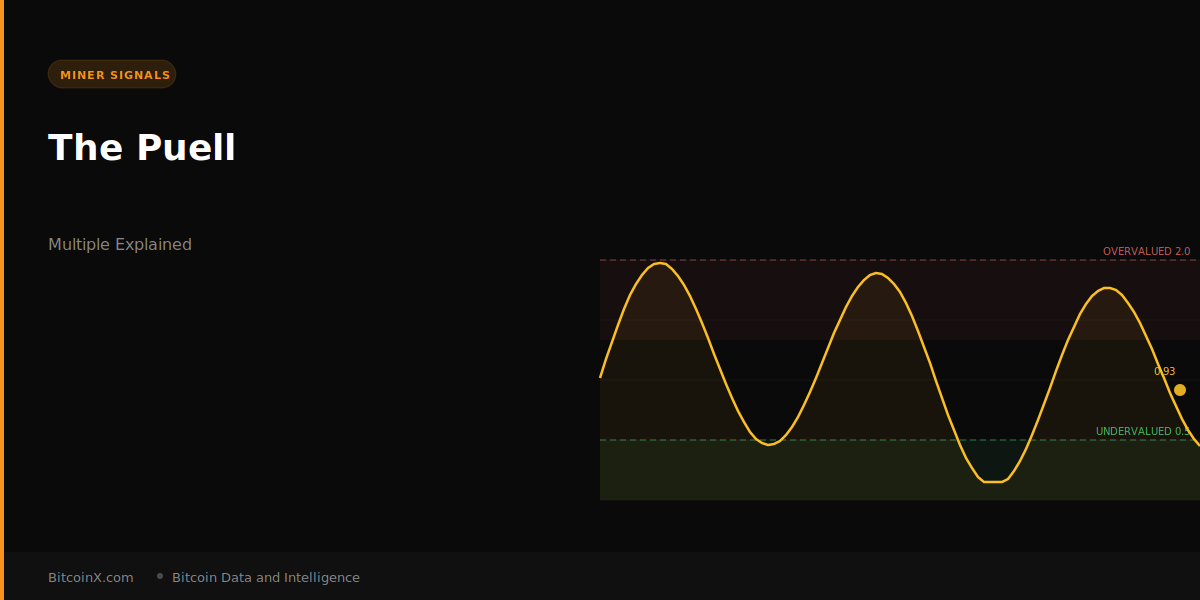
The Puell Multiple is one of the most useful — and most misunderstood — on-chain metrics in Bitcoin analysis. It measures the daily value of newly issued Bitcoin relative to the 365-day moving average of that value. In plain English: it compares what miners earn today to what they have earned on average over the past year.
When the Puell Multiple is high, miners are earning far more than their historical average — a signal that the market may be overheated. When it is low, miners are under stress and earning less than their average — historically a signal that Bitcoin is in a zone of deep value.
The Formula
The calculation is straightforward:
Puell Multiple = (Daily Bitcoin issuance in USD) ÷ (365-day moving average of daily Bitcoin issuance in USD)
Daily issuance is simply the number of new Bitcoin mined each day multiplied by the current USD price. The 365-day moving average smooths out short-term volatility, giving a stable baseline for comparison.
A Puell Multiple of 1.0 means miners are earning exactly their historical average. A value of 4.0 means they are earning four times the average — unusually high. A value of 0.5 means they are earning half the average — unusually low.
Reading the Signal
Historically, Bitcoin’s major market tops have occurred when the Puell Multiple exceeded 4.0. Both the 2013 and 2021 peaks registered Puell values well above this threshold. The 2017 peak came close. This makes intuitive sense: when miner revenue is extremely high, miners are incentivized to sell their Bitcoin to cover costs and lock in profits, creating selling pressure on the market.
Conversely, Bitcoin’s major market bottoms have occurred when the Puell Multiple fell below 0.5. The bear market lows of 2015, 2018, and 2022 all registered Puell values in this range. At these levels, only the most efficient miners can stay profitable — the marginal miner is being squeezed out, and those remaining are selling as little as possible to survive. Selling pressure from miners is at its lowest.
Why It Matters After Halvings
The Puell Multiple is particularly interesting to watch in the months immediately following a halving. When the block reward is cut in half, miner revenue drops by 50% overnight. This mechanically drives the Puell Multiple lower — often into the undervalued zone — even if Bitcoin’s price has not changed significantly.
This is precisely why some analysts argue that the period immediately after a halving represents a favorable risk/reward environment: miner stress is high, the Puell Multiple is low, and supply is structurally reduced.
Current Reading
As of our most recent data, the Puell Multiple for Bitcoin sits at approximately 0.93 — below 1.0, indicating that miners are earning slightly less than their historical average. This is consistent with the early stages of a new epoch, where the halving has compressed miner revenue but price has not yet responded decisively to the reduced supply.
Historically, a Puell Multiple in the 0.5–1.0 range has preceded significant Bitcoin price appreciation. That does not guarantee it will do so again, but the data is worth watching.
You can track the Puell Multiple alongside hashrate and difficulty in our Miner Signals dashboard, updated daily from our live data pipeline.