Bitcoin Mining Difficulty: Why It Rises and What It Means
Bitcoin’s network is designed to produce one block approximately every 10 minutes. As more miners join the network and hashrate increases, blocks would naturally be found faster — except for a mechanism called the difficulty adjustment, which recalibrates every 2,016 blocks (roughly every two weeks) to maintain the 10-minute target.
Mining difficulty is one of the most important metrics in Bitcoin — and one of the least understood by most investors.
How Difficulty Works
The Bitcoin protocol sets a target for the hash value of a valid block. Miners must produce a hash below this target to win the block reward. Lower target = harder to find a valid hash = higher difficulty. Higher target = easier = lower difficulty.
Every 2,016 blocks, the protocol looks at how long it actually took to mine those blocks. If it took less than 20,160 minutes (2,016 blocks × 10 minutes), the difficulty increases to slow things down. If it took more than 20,160 minutes, the difficulty decreases to speed things up.
The adjustment can be up to 4x in either direction per epoch, though in practice the changes are usually much smaller.
Why Difficulty Keeps Rising
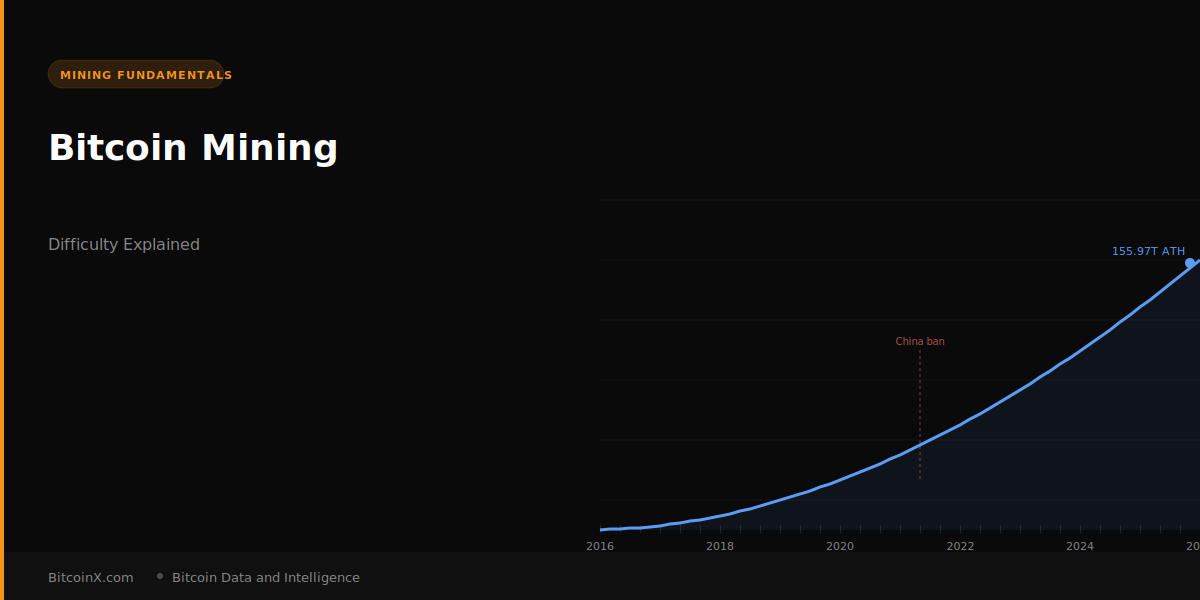
Bitcoin’s network difficulty has increased dramatically over time because the global mining industry has grown dramatically. In 2016, Bitcoin’s difficulty was in the hundreds of billions. Today it exceeds 155 trillion — an increase of over 400x in roughly a decade.
This growth reflects massive investment in specialized mining hardware (ASICs), expansion of large-scale mining operations in regions with cheap electricity, and the growing price of Bitcoin making mining more profitable and attracting more participants.
What Difficulty Tells Us About the Network
Rising difficulty is a sign of network health. It means more computing power is securing the Bitcoin blockchain, making it progressively harder to attack. The 51% attack — the theoretical scenario where a single actor controls enough hashrate to rewrite transaction history — becomes more expensive as difficulty rises.
Falling difficulty, while less common, is also meaningful. The sharp difficulty decline in mid-2021 resulted from China’s ban on Bitcoin mining, which forced a mass shutdown of Chinese mining operations. Hashrate dropped by nearly 50% almost overnight. The difficulty adjustment responded by dropping significantly — before recovering as mining operations relocated to the US, Kazakhstan, and elsewhere.
Difficulty and Miner Profitability
For individual miners, rising difficulty is a double-edged dynamic. More difficulty means each terahash of computing power earns less Bitcoin per day. A miner running 100 TH/s today earns far less Bitcoin per day than the same 100 TH/s earned in 2016 — even before accounting for the halving reductions in block reward.
This is why the miner equipment upgrade cycle is relentless. Mining hardware that was profitable two years ago may be unprofitable today, simply because difficulty has risen faster than hardware efficiency has improved.
Our Miner Signals dashboard tracks difficulty alongside hashrate and Puell Multiple daily. The current difficulty of 155.97T represents a new all-time high for the Bitcoin network.