
Bitcoin Inflation Adjusted Price
The Bitcoin inflation adjusted price shows what BTC is actually worth in today’s dollars — stripping out the effect of currency debasement so you can see real purchasing power, not just nominal price.
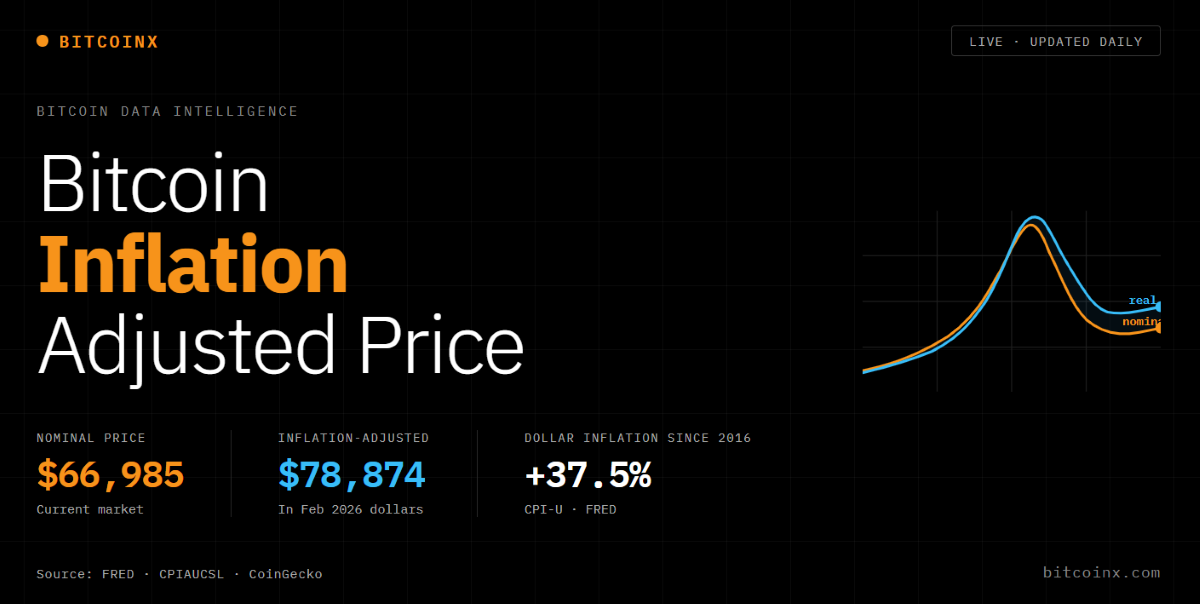
This tool uses the Consumer Price Index (CPI-U) from the Federal Reserve to adjust every daily Bitcoin close price back to February 2026 dollars. When the real price runs above the nominal line, Bitcoin has outpaced inflation over that period. When it runs below, the dollar has eroded more than BTC has gained.
Data is sourced from FRED (CPIAUCSL series) and updated monthly. Bitcoin price data updates daily.
The Bitcoin inflation adjusted price strips out dollar debasement to show BTC’s real purchasing power over time. Since 2016, cumulative U.S. inflation has exceeded 37% — meaning every nominal price in history understates what Bitcoin actually cost in today’s dollars. Use this alongside the Fear and Greed Index to see how sentiment tracked against real value, or visit the Halving Tracker to understand how supply cycles have shaped the inflation-adjusted price over each epoch.
What Is This Data?
The Bitcoin inflation adjusted price is the nominal BTC price recalculated to account for the purchasing power of the U.S. dollar at a fixed point in time. Rather than asking what Bitcoin cost in 2017, the inflation-adjusted view asks what that 2017 price means in today’s dollars.
This matters because inflation silently erodes the value of any fixed number. A Bitcoin price of $20,000 in late 2022 is not the same as $20,000 today — the dollar buys less now than it did then. Adjusting for CPI makes historical comparisons honest.
How the CPI Adjustment Works
Each daily Bitcoin close price is multiplied by a ratio of the current CPI to the CPI reading for that date’s month:
Real Price = Nominal Price × (Base CPI ÷ Historical CPI)
CPI data comes from the Federal Reserve Economic Data (FRED) CPIAUCSL series, published monthly by the U.S. Bureau of Labor Statistics. The base month is the most recent available CPI reading, which updates monthly.
What the Data Shows
Since 2016, cumulative U.S. dollar inflation has exceeded 37%. That means a dollar today buys roughly 27% less than it did a decade ago. Despite Bitcoin’s notorious volatility, its inflation-adjusted price has significantly outpaced that erosion over the full period.
The chart makes three patterns visible that the nominal price obscures: early-cycle Bitcoin was far cheaper in real terms than it appeared, the 2021 peak was even more extreme adjusted for inflation, and recent consolidation looks different once dollar weakness is removed.
Bitcoin as an Inflation Hedge
Bitcoin’s fixed supply of 21 million coins is frequently cited as a hedge against inflation. Unlike fiat currency, no central bank can expand Bitcoin’s supply. Whether it functions as a reliable hedge in practice depends on the time horizon — short-term correlation with risk assets is high, but the long-term inflation-adjusted return has been extraordinary. For more on supply dynamics, see the Bitcoin Halving Tracker and Bitcoin Miner Metrics.
Bitcoin Inflation Adjusted Price FAQs
Is the inflation adjusted Bitcoin price higher or lower than nominal? It depends on the date. For most of Bitcoin’s history since 2016, the real price runs higher than the nominal price — because the dollar has lost purchasing power and that loss is added back in. In periods of very low inflation, or when the base CPI month is close to the data point, the lines may converge.
Why does the chart use CPI-U specifically? CPI-U (Consumer Price Index for All Urban Consumers) is the most widely used U.S. inflation benchmark, covering approximately 93% of the U.S. population. It is published monthly by the Bureau of Labor Statistics and is the standard reference used in inflation-adjusted financial analysis.
How often does this data update? Bitcoin price data updates daily. CPI data updates monthly when the Federal Reserve publishes new CPIAUCSL figures — typically mid-month for the prior month. See the Bitcoin Price Dashboard for live nominal price data.
CPI data is sourced from the Federal Reserve Economic Data (FRED) CPIAUCSL series and updates monthly.